Ask anyone who’s spent a summer evening in Positano what they drank after dinner, and you’ll probably hear about a tiny frosted glass of something bright yellow, bitterly cold, gone before you’ve really noticed. Amalfi Coast limoncello is just part of life on that stretch of coast. Lately, pistachio liqueur — a green cousin from Sicily — has been gaining ground fast.
So if either bottle’s on your list, here’s what’s actually worth knowing: how they’re made, what to look for on the label, how to serve them properly, and what tells the real thing apart from one coasting on the word “Italian” alone.
What Sets Amalfi Coast Limoncello Apart
Lemons are really the whole story here. Limoncello gets made all over the place — Sorrento, Capri, Sicily, factories well outside Italy entirely. Real Amalfi Coast limoncello, though, starts specifically with lemons grown on the terraced hillsides above towns like Amalfi, Minori, and Maiori. Nothing else counts, honestly.
The Lemons Make the Difference
The local variety goes by Sfusato Amalfitano — long, knobbly, a thick peel loaded with fragrant oils, and flesh that’s notably less sour than anything you’d pull off a supermarket shelf. Since limoncello’s made from the peel rather than the juice, that oily rind is doing almost all the work here. Lemons grown along this stretch of coast can carry the protected “Limone Costa d’Amalfi IGP” label — a reasonably solid sign the fruit’s actually local, not trucked in from somewhere cheaper to cut corners.
How Amalfi Limoncello Is Made the Old-Fashioned Way
The traditional method is almost suspiciously simple. Which, frankly, is exactly why it’s so easy to cut corners.
Lemons get peeled by hand first — just the thin yellow zest, since the white pith underneath goes bitter fast, so careful producers strip it away entirely. From there, the peels soak in pure alcohol, days or sometimes weeks, until the colour and aroma have fully come through and the liquid’s turned a deep egg-yolk yellow. Strained next, mixed with a plain sugar-and-water syrup, left to rest, filtered, bottled. Not a lot more to it, honestly.
Done right, Amalfi limoncello tastes like actual lemon peel, not lemon candy — sweet, sure, but with a sharpness running right through it. Cheaper bottles paper over weaker fruit with flavourings or added colour, and that trick almost always gives itself away the moment it touches your tongue.
A Closer Look at Buona Italia’s Limoncello Amalfi Coast Bottle
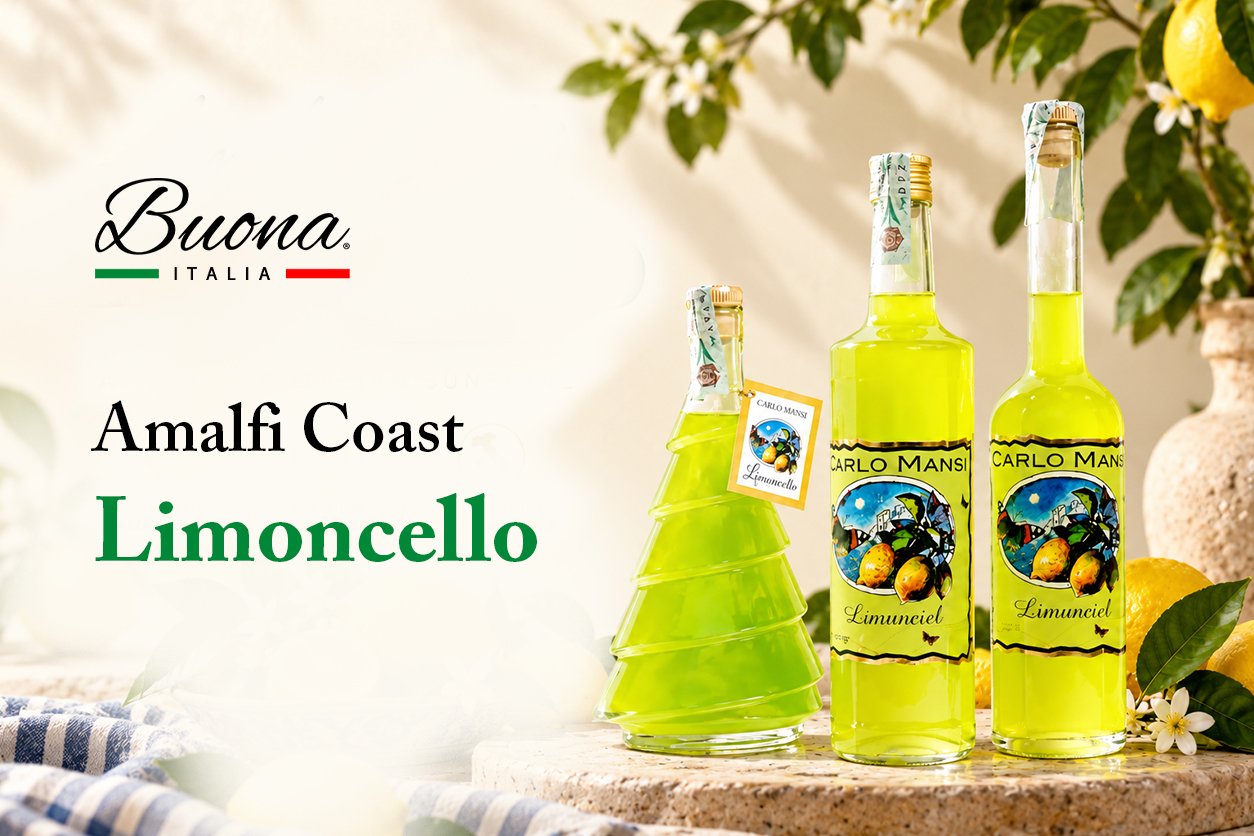
The Artisanal Limoncello from Amalfi sold by Buona Italia comes from Carlo Mansi Liqueurs, a producer based in Amalfi itself, in the Campania region. The family recipe’s been passed down through generations at this point. Every lemon is organic, Amalfi-grown, and peeled entirely by hand. The liqueur sits at 30% ABV — squarely within the normal range for limoncello.
Prices currently start from $28.50. For something a bit fancier, Buona Italia also sells the same liqueur in a hand-painted ceramic jar from $59.90. And for a sweet extra, there’s a babà cake soaked in the same limoncello Amalfi Coast producers have been using for generations.
Buying Tips for Limoncello from Amalfi, Italy
“Amalfi” and “Italy” get printed on a lot of bottles that have never seen either place, so a bit of label-reading goes a long way. Look for an actual producer’s name and a town of origin. If all it says is “Italian style,” take that as a warning sign and move on. Check the ingredient list too — real limoncello from Amalfi, Italy should list little beyond lemon peel, alcohol, sugar, and water.
Colour’s a clue on its own. Natural limoncello runs a slightly cloudy, sunny yellow. A neon, see-through yellow usually means colouring got added somewhere along the way.
For anyone ordering online in the US, Buona Italia ships to both the US and Canada. Orders over $99 come with a gift, and orders over $199 ship free — which makes a second bottle, or a few pantry items, worth tossing in.
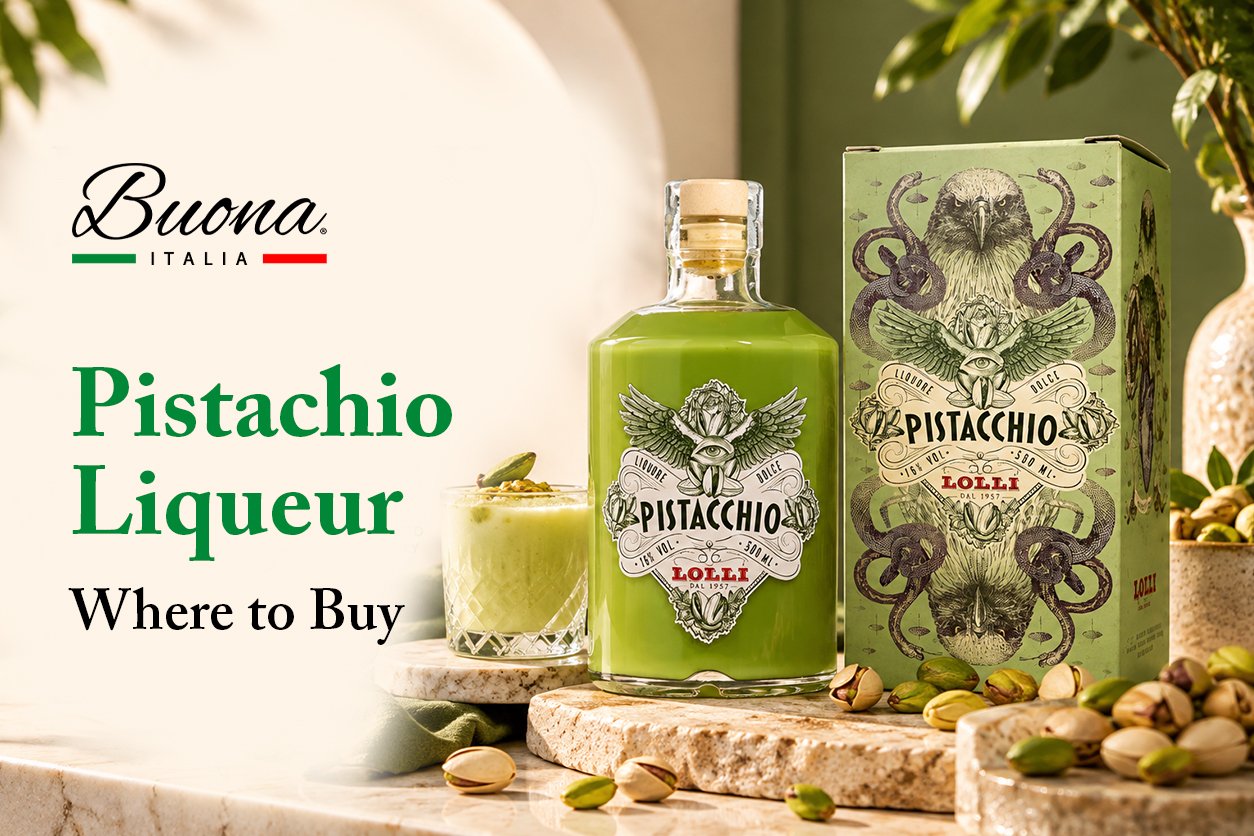
Moving On to Italian Pistachio Liqueur
Pistachio liqueur calls a different part of Italy home. Most of the well-known bottles come out of Sicily, frequently made with pistachios grown on the volcanic slopes around Mount Etna. Bronte’s the most famous source, and its pistachios carry a protected DOP label — small, intensely green, and noticeably stronger-tasting than whatever’s in a bag of snack nuts.
A decent Italian pistachio liqueur should taste of roasted nuts first, sugar second. If all that comes through is sweetness with a faint hint of almond somewhere in the background, the actual pistachio content probably isn’t very high at all.
Pistachio Cream Liqueur vs Clear Pistachio Liqueur
There are two broad styles out there, and it’s worth knowing which one you’re actually buying before the bottle shows up.
The creamy kind is the one you’ll spot most often. Producers grind the pistachios into a paste, then work it into alcohol, sugar, and either cream, milk, or a dairy-free base. What comes out runs thick, smooth, not far off melted pistachio gelato. A pistachio cream liqueur usually lands around 17% to 18% ABV — noticeably gentler than limoncello. A fair few brands skip dairy altogether too, which helps if someone at the table can’t do lactose.
The clear or traditional style is made by soaking or distilling the nuts straight in alcohol, no cream involved. It runs thinner, usually stronger, less sweet overall — more of a sipping digestif than anything resembling a dessert drink.
Pistachio Liqueur Where to Buy: What to Check First
Plenty of people type “pistachio liqueur where to buy” into Google and end up with something that’s mostly sugar and green food colouring. To steer clear of that, look for Sicilian pistachios named specifically on the label — Bronte, ideally — and check the nut percentage if it’s listed. Make sure you actually know whether it’s the cream style or the clear style before ordering. Cream liqueurs also need a bit more care once opened: keep them refrigerated, and finish the bottle within a few months.
Specialty Italian food importers tend to be a safer bet than big general liquor stores here. They usually stock smaller producers and can actually tell you where the nuts came from.
Serving Both at Home
Keep limoncello in the freezer — the alcohol stops it from freezing solid, and it should pour almost syrupy-cold into small, chilled glasses. Pistachio cream liqueur does better in the fridge than the freezer, since very low temperatures can thicken it past the point of enjoyment. Pour it over ice, stir it into coffee, or drizzle it over vanilla ice cream and call it dessert.
FAQs
How is authentic Amalfi limoncello traditionally produced?
Slowly, and mostly by hand. Someone peels every single lemon with a knife, taking only that thin yellow layer. The white pith stays behind, since even a little of it turns the drink bitter. The peels steep in pure alcohol until it goes the colour of egg yolk. Next comes a simple syrup of sugar and water. The mix rests, gets filtered, then bottled — no shortcuts, no added colouring. Grandmothers on the coast still make it exactly this way in their own kitchens.
Why is limoncello Amalfi Coast popular among Italian liqueur lovers?
We'd guess it's the memories, honestly. So many customers first tasted it at a small trattoria on holiday, poured by the owner without even being asked. Then they got home, bought a cheap bottle somewhere, and were disappointed by the gap. The real thing brings that trip straight back. Plus, it's cold, sweet, and sharp all at once — and that combination genuinely never gets old.
Where can you buy authentic limoncello from Amalfi, Italy?
Look for an importer that tells you exactly who made it. Ours comes from Carlo Mansi Liqueurs, a family producer in Amalfi, and it ships anywhere in the US and Canada. Shopping elsewhere? Turn the bottle around first. A real one names the town and keeps the ingredient list short. "Natural flavors" on the label is a red flag worth taking seriously.
How should Amalfi Coast limoncello be served?
Freezer-cold — don't worry, it won't actually freeze solid. Small glasses, chilled if you remember to. Italians usually pour it after dinner and sip it slowly while everyone's still talking at the table. In summer, a splash in prosecco with plenty of ice works nicely too.
What foods pair well with Amalfi limoncello?
Anything light and a bit sweet. Lemon cake, obviously. Ricotta tart works well too, or a few almond cookies, or a scoop of sorbet. Babà soaked in limoncello is a personal favourite, and a slightly dangerous one. After a big seafood dinner, one cold glass clears the palate nicely too.
What is Italian pistachio liqueur made from?
Pistachios, alcohol, sugar — that's the base of it. The bottles actually worth buying tend to use Sicilian nuts, and the most famous ones come from Bronte, a small town on the slopes of Mount Etna. Bronte pistachios run tiny, almost emerald green, and taste far more intense than whatever's in a bag of salted snack nuts. Creamy versions grind the nuts and blend them with cream, milk, or a plant-based stand-in.
How does pistachio cream liqueur differ from traditional pistachio liqueur?
One's basically melted gelato. The other's a proper digestif. Cream liqueur runs thick and sweet, sitting around 17 to 18 percent alcohol — great over ice cream, or stirred into coffee. The traditional style drops the cream entirely, so it ends up thinner, drier, usually stronger too. The kind you sip slowly, on its own, once the meal's done.